RUAF-led research on food security narratives identifies opportunities and strategies for shaping food security narratives to support climate mitigation and adaptation – in ways that give agency to farmers and local communities, rather than being dominated by powerful corporations. Download the report here.
Food security has surged in recent years, driven by geopolitics, climate change, economic disruptions, the enduring effects of the COVID-19 pandemic and natural resource constraints.
Impacts such as shifting weather patterns and degraded soils can pose serious threats to agricultural productivity and food system resilience. At the same time, food systems currently account for roughly 30 percent of total greenhouse gas emissions globally, with emissions from agricultural production (primarily methane and nitrous oxide) on the rise since 2000.
Despite this, food security and climate action are too often treated as separate or conflicting agendas – when in fact there is tremendous potential for climate mitigation through food systems.
The new research, commissioned by ClimateWorks Foundation, set out to understand how food security narratives are shaped by competing narratives – that is, the way people talk about and understand food security, what they see as being the main problems, the solutions envisaged, and underlying norms, values and assumptions.
As well as identifying which food security narratives have the greatest potential to support climate actions and give agency to farmers and communities, the research gives helpful guidance for identifying opportunities to shape narratives and strategies to maximize them.
Among the core messages, the research found the most effective intervention is not to directly oppose dominant productivist narratives that maintain food security is achieved through increased production, often with innovative agritech, especially to cater to a growing world population, but to strategically elevate and resource alternatives.
This includes food sovereignty in Latin America and parts of Africa where it has constitutional or policy traction, agroecology where it has demonstrated community adoption, civil food resilience in the Global North and rights-based approaches where constitutional or legal frameworks exist. A common characteristic of these alternatives is that they are locally embedded, based on lived experience and emphasize the agency pillar of food security.
We really need to amplify local voices and build support for organizations that promote locally embedded narratives that tend to be ignored by governments, thereby boosting local resilience, capacity and livelihoods. – Jess Halliday, Chief Executive of RUAF
Who the report is for
The primary audience of the research report is climate-focused philanthropic funders, based on the understanding that food security narratives ultimately determine which policies receive funding, which technologies are scaled and which communities are empowered or left behind.
The research found that philanthropy should work to expose the gap between productivist climate rhetoric and actual climate outcomes, making visible how corporate-driven “solutions” perpetuate the very systems driving emissions. This recognizes that narrative power is unevenly distributed but identifies specific leverage points where philanthropic investment can amplify alternatives that align food security with effective climate action.
Beyond philanthropy, the research serves as a toolkit for all other stakeholders who adopt and use narratives in strategic, communicative and interpretive ways to influence the food and climate ecosystem – including NGOs, community groups, academic-activists, farmers’ organizations, public sector officials and business of all kinds and sizes.
In addition to presenting a porous typology of the main narratives and the trends between them, it identifies six opportunities for shaping food security narratives to promote climate action:
- Global and regional/continental summits and events offer advocacy moments.
- Ongoing global governance spaces and processes allow for continuous influence.
- National strategies and plans, including consultations and multistakeholder platforms, offer opportunities for recurring influence.
- Political moments, including electoral cycles and anniversaries, create windows for new narratives.
- External events and crises that prompt public dialogue shifts.
- Working with sectors on an on-going basis allows for gradual influence.
Strategies for harnessing food security narratives to advance climate action are:
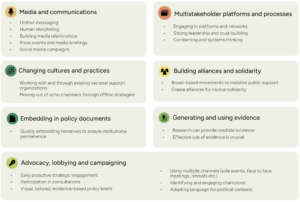
How we carried out the research
The research was led by RUAF, in partnership with regional partners: Comida do Amanhã, Zero Hunger Institute and Regenera Institute (South America); the African Food Systems Transformation Collective (established by the African Climate Foundation); the Global Alliance for Improved Nutrition; and independent consultants in India, Bangladesh, Indonesia and Sri Lanka.
The research was conducted in three phases. Phase one involved a review of academic literature and grey literature across five global regions, with particular focus on certain countries: Africa (Kenya, Mali, Nigeria and Zimbabwe); South America (Brazil, Costa Rica, Colombia and Chile); South and South East Asia (India, Bangladesh, Sri Lanka and Indonesia); Europe (the European Union and the United Kingdom); North America (the United States and Canada).
Phase two involved expert interviews and stakeholder consultations, with a total of 43 interviews conducted across the five regions and among experts operating at the international level.
Phase three involved strategic engagement through an online workshop that enabled the team to check the draft findings with selected food security experts.
More information
Download the full report ‘Shaping food security narratives: A strategic tool for climate action’ here.
Download the ClimateWorks summary of the report for philanthropic funders here.