Members of the RUAF Youth Working Group (YWG) simulated how the Committee on World Food Security (CFS) negotiates policy recommendations on urban agriculture, joined by two guests from the Civil Society and Indigenous Peoples’ Mechanism (CSIPM). The exercise demonstrated that global policy processes, though often perceived as distant, are within reach for young people—and that they can meaningfully contribute to them.
Building on Webinar 3—which unpacked the CFS Policy Recommendations on Promoting Youth Engagement and Employment in Agriculture and Food Systems—Webinar 4 aimed to give participants a practical feel for how the CFS operates in real life. To do this, the group negotiated a set of draft recommendations on urban agriculture.
The session opened with participants delivering prepared statements aligned with the roles they had chosen to play, outlining their stance on urban agriculture. Participants were then divided into two groups to refine their proposals, each focusing on a different theme:
- Governance & policy: How can governments and cities better integrate urban agriculture into national food strategies and land-use planning? What incentives or legal frameworks are needed
- Implementation & resources: How can urban agriculture be scaled sustainably? What solutions exist for access to land, finance, water, youth inclusion, and innovation?
Back in plenary, the two groups negotiated their statements until they reached consensus, after which Member States announced whether they endorsed the final recommendations.
While this simplified process is not how the CFS negotiates in practice—where discussions span months and all actors work on all topics—this adapted approach maximized participation and allowed everyone to contribute meaningfully within the webinar format.
The presence of two CSIPM guests, including one playing the role of Italy, added realism and insight. Their participation was made possible thanks to Samuel Ikua, co-coordinator of the YWG and long-standing CSIPM member, who brokered the connection.
This simulation was especially valuable because it made an abstract process feel real and hands-on, and it gave us a feel of what it’s like to step into leadership roles. – Manon Roux-Dessarps

Key outputs and reflections
After group work, negotiations, and detailed refinement (down to commas and capital letters), participants agreed on three final statements:
- Recognize and protect urban agriculture as an official land use.
Governments should formally integrate urban agriculture into national food policies and zoning regulations by creating Urban Agriculture Zones, allowing production across multiple land-use categories, and safeguarding peri-urban farmland through tools such as land trusts, long-term leases, public land allocation, and land-matching programs. - Provide financial and regulatory incentives to make urban agriculture viable.
Municipalities should enable adoption by offering grants, microloans, subsidies for soil remediation and irrigation, tax reductions for landowners, and simplified licensing processes, while supporting direct-to-consumer markets like farmers’ markets and short supply chains. - Integrate urban-grown food into formal food systems through public policy.
Governments should embed urban agriculture into food governance by including it in public procurement schemes, facilitating institutional purchasing, and ensuring UA is reflected in national food strategies, climate plans, and urban resilience frameworks.
The exercise revealed the depth of knowledge within the YWG—from practical expertise to policy understanding—and highlighted the openness, curiosity and collaborative spirit in the room. Negotiations were far more peaceful than those often seen in Rome, yet no less rigorous. Despite the short time available, participants thought on their feet, adapted and found consensus.
For the YWG, this was a chance to learn from one another, gain confidence navigating global governance spaces, and reinforce the understanding that young people have a place in these processes and can meaningfully contribute. Experiences like this help bridge the gap between local practice, youth perspectives and international policy arenas.

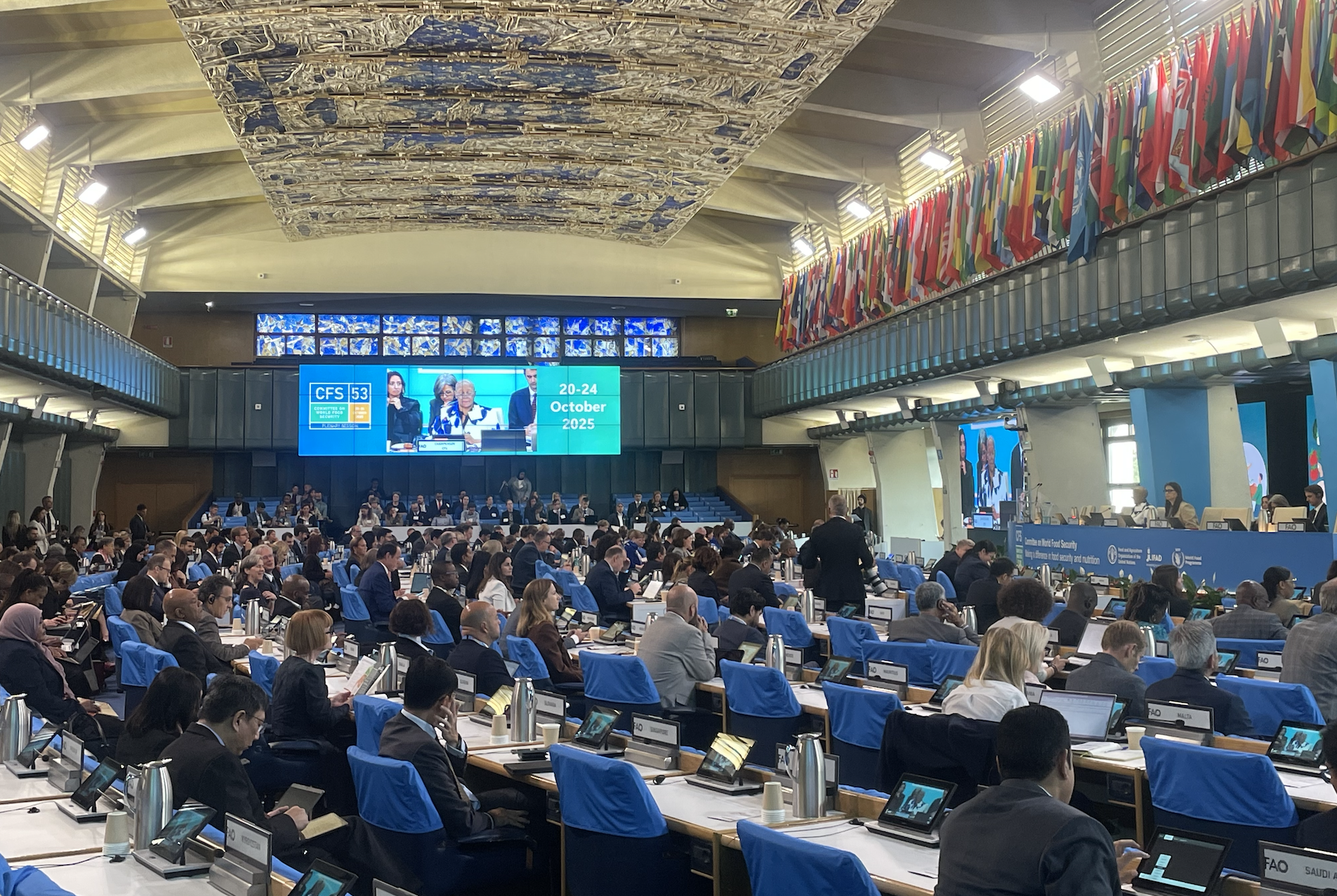
The CFS policy process
The CFS is the UN’s most inclusive global platform for food security and nutrition. It includes:
- Member States (the only actors with voting rights)
- Civil Society and Indigenous Peoples’ Mechanism (CSIPM)
- Private Sector Mechanism (PSM)
- Philanthropic Foundations Mechanism (PFM)
- UN agencies (FAO, WFP, IFAD)
- International research bodies (e.g., CGIAR)
- Financial institutions (e.g., AfDB, World Bank, IMF)
- Observers, including local authorities and regional associations
Together, they debate, negotiate and eventually endorse policy recommendations and voluntary guidelines that inform and shape global food governance.

Looking ahead
We extend our sincere thanks to all participants—and to our CSIPM guests—for their valuable insights and for helping to make the simulation as professional and realistic as possible.
We look forward to the YWG 2026 programme as we continue to learn together, strengthen connections among participants and foster deeper roots across the RUAF network.